
Written by Alexandre Bridi
27 September 2026 · 3 min read
Licensing one article to an AI company sounds simple, and with a month and a lawyer it is. Doing it in seconds, for thousands of articles and many buyers, is a different matter. Five things have to be true before money can change hands with any confidence: the seller must own the work, the terms must be stated, a licence must be issued, its use must be recorded, and the publisher must be paid.
None of these is new. Picture agencies and music societies have done each of them for decades. What is new is the speed. An AI system deciding whether to use an article does so in the time it takes to answer a question, so every step has to work without a human in the loop.
1. Prove ownership
A licence is only as good as the seller's title to the work. The point is not academic. The $1.5bn settlement Anthropic agreed with authors, which a judge approved in July, turned on copies whose provenance would not survive scrutiny. A buyer who pays the wrong party has bought nothing.
Proving ownership online means asking the seller to do something only the owner could do: change the publication's own pages, its domain records or its platform settings.
2. State the terms
Terms have to be written so that software can read them before it buys. That means naming each use separately, because an AI company might want to answer questions with an article, show it to clients, keep a catalogue for in-house search or train a model, and a publisher may welcome one and refuse another. It also means attaching a price to each. Open formats for this are emerging; the RSL standard, for instance, lets a publisher state permitted uses, prices and reporting duties in a file that sits alongside its site.
3. Issue the licence
When a buyer pays, a licence is created: a record of who bought what, for which use, on which terms and at what price. It needs a reference both sides can quote, and it must be impossible to rewrite quietly later, because a licence is evidence in exactly the situations where the two sides disagree.
4. Record each use
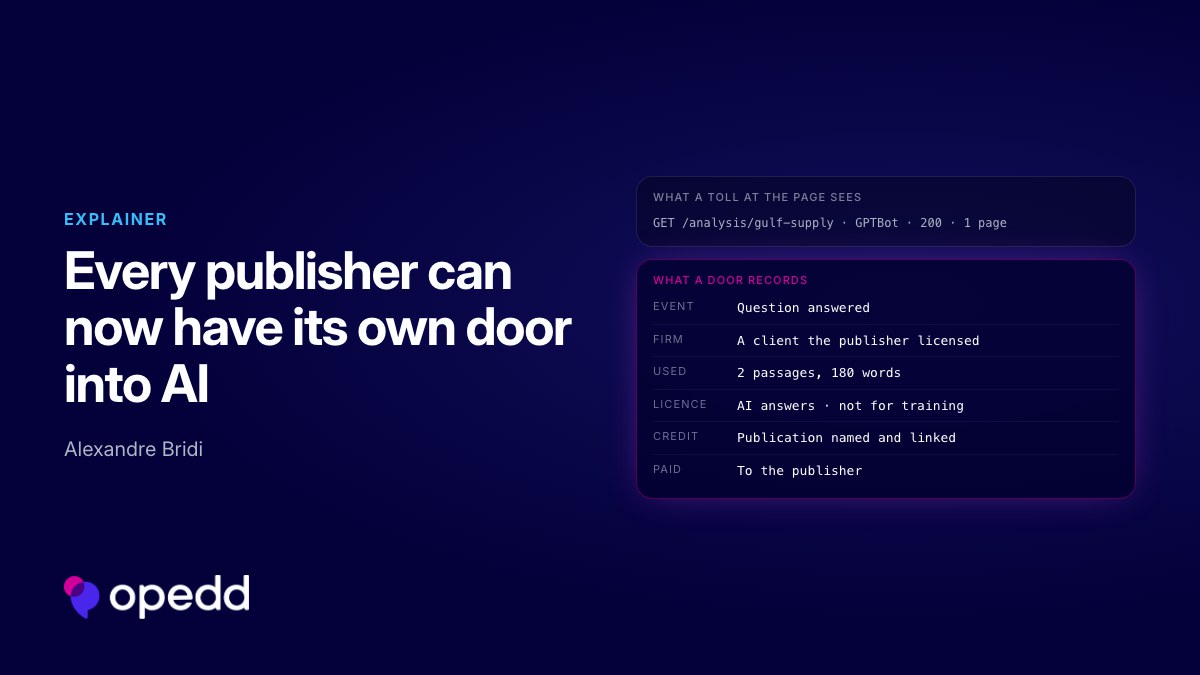
A licence that covers answers is only fully useful if each answer is counted. Traffic and citations are poor proxies; an article can shape a conclusion without being linked. When articles are delivered through an interface built for the purpose, such as an API or the servers AI agents connect to, each use can be recorded as it happens, against the licence that allowed it. That is what makes paying by use possible, rather than a lump sum agreed in advance.
5. Pay the publisher
The last step is the one publishers care about most and think about least. Money has to reach the right account, in the right currency, with a statement that matches the records of use. Single sales can be paid as they happen; answers are better added up and paid monthly.
How this works on Opedd
On Opedd, a publication imports its articles from Substack, Beehiiv, Ghost or any website through our API, and proves ownership using one of the six methods above. The publisher sets a price for each use and can switch any of them off. AI companies license through one agreement and receive articles through the API or the Opedd MCP server, and every licence gets its own key and a tamper-evident record. Answers are recorded one by one. The publisher keeps 80% of each sale, paid through Stripe, and needs to connect a Stripe account only once there is money to receive.
Setting up a publication is the easy part. The harder part, which the five steps exist to settle, is making sure that whatever happens afterwards can be trusted by both sides.