
Written by Alexandre Bridi
4 October 2026 · 4 min read
Ask what an article is worth to an AI company and the honest answer is that nobody publishes the number. Most licensing deals are lump sums for a publisher's entire output, struck under non-disclosure agreements. A few prices have nonetheless escaped, and they say more about how to set a price than about what the price should be.
The prices we know
The clearest is from books. Microsoft offered HarperCollins $5,000 per non-fiction title for three years of training use, split equally between publisher and author. Authors had to opt in, and the deal limited how much of each book could be reproduced. The second comes from a courtroom: the settlement between Anthropic and authors, approved in July, pays about $3,000 per book. That is compensation for pirated copies rather than a price anyone agreed to, but it now sits in every negotiator's head.
For news and analysis, only lump sums are public. OpenAI pays Dotdash Meredith at least $16m a year, plus a part that varies. Amazon pays The New York Times $20m–25m a year. Dividing such sums by the number of articles produces a figure, but not a useful one. A national newspaper's deal buys its brand, its breadth and an end to legal risk as much as its text.
Price the use, not the words
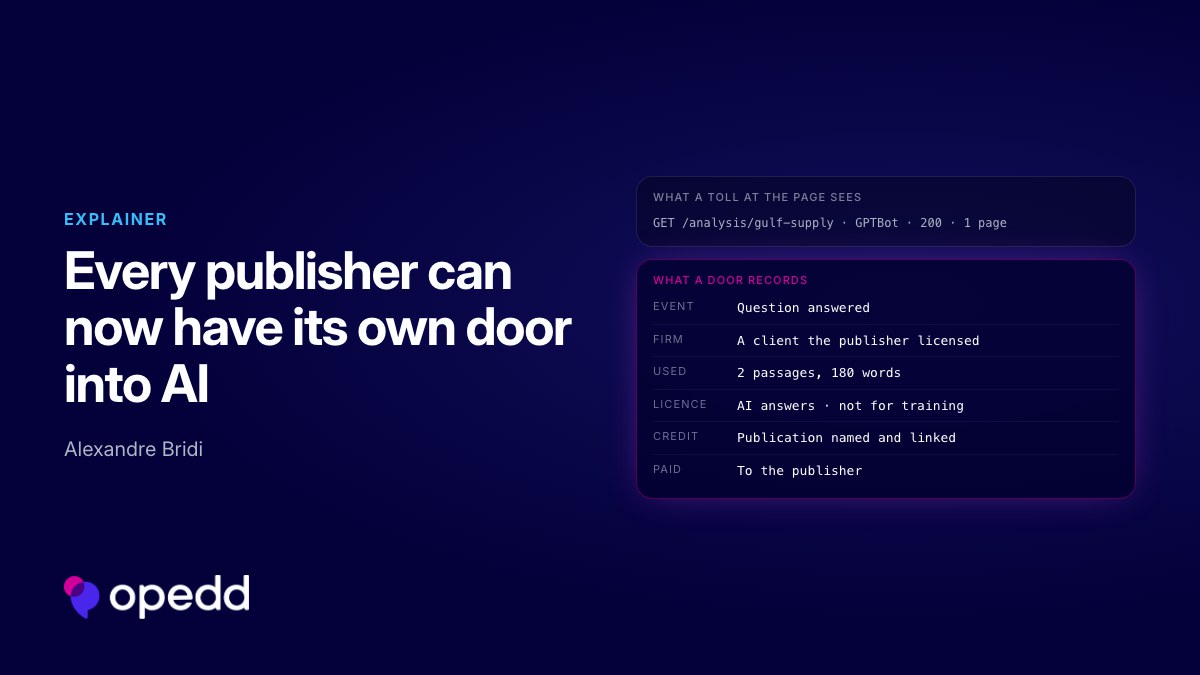
The more useful lesson from the deals is what they pay for. An AI company can do four quite different things with an article. It can use it to answer a question. It can show it to its own clients. It can keep a copy of a whole catalogue for its in-house search. Or it can train a model on it. Each deserves a different price, for a reason that is easy to miss: some of these uses can be taken back, and some cannot.
Answers and client display recur. They are priced as they happen, per answer or per client each month, and they stop when the licence does. A publisher who sets the price too low can change it. Training is different. Once a model has learned from an article there is no practical way to make it forget, so a training licence is in effect permanent. The same is true, in a weaker sense, of a catalogue kept in someone else's system. You can stop selling answers tomorrow. You cannot untrain a model. That asymmetry is the strongest argument for pricing training once, and high, or not at all.
What raises the price
Scarcity. If an analysis exists nowhere else, a research tool cannot answer the question without it. A summary of yesterday's interest-rate decision is available in a thousand places; an expert's reading of a shipping insurer's balance sheet is not.
Timeliness. Answers are about the present. An article that arrives while the question is still live is worth more than the same article a month later, which is why real-time access now features in most large deals.
Clean rights. Buyers pay for certainty. HarperCollins could sell because its authors opted in; Anthropic paid $1.5bn because its copies had no such provenance. A publisher who can show that it owns what it sells, and has not licensed it away elsewhere, is offering the buyer something it cannot get from a web crawl.
Not volume alone. A large catalogue raises the value of a training or catalogue licence. It does little for answers, where one relevant article beats a hundred adjacent ones.
A practical starting point
Start with answers, because they are the use most AI companies need and the easiest to reprice. Set the price you would accept for one of your articles informing one client briefing. Price display by the client, since its value grows with the buyer's own audience. Price training last, separately and high, and feel free to decline it.
That is how pricing works on Opedd. A publisher sets a price for each of the four uses, can switch any of them off, and keeps 80% of every sale; there is no subscription or set-up fee. Switching a licence off applies to new sales, so buyers who have already paid keep what they bought, which is also why the irreversible uses deserve the most thought before they are switched on.
No public figure yet says what an article is worth to an AI company. The deals do show that the price depends less on the article than on what the buyer intends to do with it.